One of the most exciting moments of the 603 Writers’ Conference is the annual 603 Pitch Party — a chance for writers to distill their book idea, practice the art of pitching, and potentially receive valuable recognition in front of agents, editors, publishing professionals, and fellow writers.
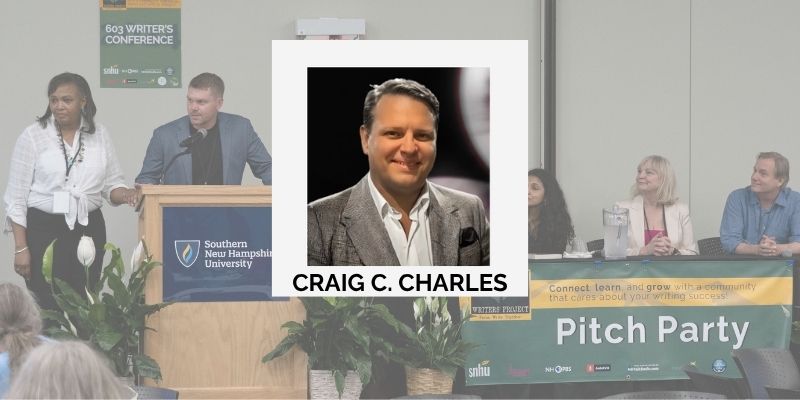
But the Pitch Party is more than a competition. For Craig C. Charles, winner of the 2024 603 Pitch Party, the experience became a clarifying moment: a way to better understand his own story, sharpen his message, and take a meaningful step forward in his writing journey.
We spoke with Craig about what it felt like to hear his name announced, how he prepared his winning pitch, and why he encourages writers to submit — even if they don’t feel completely ready.
Can you describe the moment you were announced as the winner of the 2024 603 Pitch Party?
The finalists remained a mystery until the end of the conference. The judging panel had narrowed the submissions down to five pitches, and as each finalist was announced, the surprised writer was invited to the stage. A voice actor read each pitch and logline aloud, and then the judges asked the writer questions.
“I was the last finalist announced, and to be honest, I was in a state of shock,” Craig shared. “I went up on stage and listened as my pitch was read. The judges asked me several questions, which I honestly don’t even remember now.”
After all five pitches were presented, the judges conferred.
“Then, my name was announced as the winner, and I was absolutely floored. It was a truly gratifying and validating experience.”
How did you prepare your pitch?
Like many writers, Craig entered at the last minute.
“I entered the pitch competition at the eleventh hour, giving myself just one day to compose my 125-word pitch and a one-sentence logline,” he explained.
At the time, he was deep in another round of editing his manuscript, The Chronicle of the Versemaker, and struggling to narrow down its many plot lines and points of view.
“I wasn’t even thinking about querying or pitching my story to others,” Craig said. “But I thought perhaps focusing on a pitch would help me pinpoint what the story was truly about.”
That instinct turned out to be exactly right.
His first attempt at the 125-word pitch was more than 450 words. To cut it down, he broke the story into key components: setting, plot, conflict, and urgency. From there, he tightened each sentence until the pitch fit the required length.
The same strategy helped with the one-sentence logline. By breaking it into comparable titles, conflict, and setting, Craig was able to create a clearer, stronger summary of the book.
What did the Pitch Party help you understand about your own story?
The process of writing a pitch forced Craig to step back and ask one of the hardest questions writers face:
What is this book really about?
That clarity became useful well beyond the competition.
The pitch and logline helped define the heart of the book, and the material later became useful in promoting the novel as well.
“My pitches even ended up as marketing materials for my book,” Craig said.
What advice would you give writers who are thinking about entering the 603 Pitch Party?
Craig’s advice is simple: submit a pitch.
“Even if you haven’t finished your draft, I’d encourage writers attending the 603 Conference to submit a pitch,” he said. “The process of writing a pitch and a one-sentence logline can truly add clarity to your story and be a great help later if you decide to query agents.”
For writers who feel intimidated by the process, this is a helpful reminder: you do not need to have everything figured out before you begin. Sometimes the act of preparing a pitch helps you discover what your story has been trying to become all along.
How has the New Hampshire writing community influenced your work?
Community played a major role in Craig’s development.
After winning a charity auction for a coaching session with author Jamie Ford, Craig received a piece of advice that stayed with him: become more active in a local writing community.
That advice led him to join the New Hampshire Writers’ Project.
The encouragement, connection, and creative energy of a writing community can make a significant difference, especially for writers working through the long and often solitary process of drafting, revising, publishing, and promoting their work.
What’s next in your writing journey?
After independently publishing two novels, Craig is now working on a third project: a historical literary mystery with a dual timeline, including one storyline set at Dartmouth College in the late 1970s.
This time, he plans to explore traditional publishing and seek representation from an agent.
He has already completed the 75,000 word manuscript and has been querying it since August 2025.
“For me, success means continually improving my craft,” Craig said. “I’m eager to grow my team and expand my readership.”
Why attend the 603 Writers’ Conference?
The 603 Writers’ Conference is designed for writers who are ready to learn, connect, grow, and take the next step in their creative journey.
Whether you are drafting your first manuscript, revising a work-in-progress, exploring publishing options, building your author platform, or preparing to pitch, the conference offers a full day of inspiration, practical education, and community.
And for writers with a book idea they want to sharpen, the 603 Pitch Party offers something especially valuable: a deadline, a challenge, and a chance to clarify the heart of your story.
You may walk in thinking you are “just submitting a pitch.”
You may walk out with a stronger understanding of your book, new confidence in your work, and a clearer path forward.
Ready to Join Us?
If you are attending this year’s 603 Writers’ Conference, consider submitting to the 603 Pitch Party. You do not have to feel perfectly ready. You just have to be willing to try.
Your pitch may help you find the clearest version of your story.
And that could be the first step toward something much bigger.
The deadline for the 2026 Pitch Contest is is May 30. Entries can be sent to submissions@nhwritersproject.org.
To learn more about Craig, visit CraigCCharles.com.