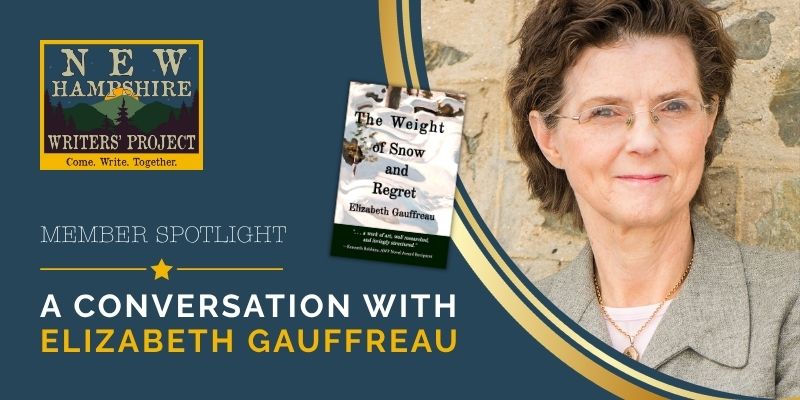
When Elizabeth “Liz” Gauffreau launched her novel The Weight of Snow and Regret with the Sheldon Historical Society, the event became more than a traditional author presentation.
Community members shared personal connections to the Sheldon Poor Farm, reflected on how society has treated people experiencing poverty and hardship, and considered how fiction can help readers understand the human experience behind historical events.
A longtime member of the New Hampshire Writers’ Project, Liz spoke with NHWP about the launch, the research behind her novel, and the writing programs that have shaped her work.
What surprised you most about the launch turnout?
What surprised me most was the number of people who had some connection to the poor farm and were willing to share.
Their participation made the event feel like more than a book launch. It became a community conversation about a part of local history that still carries personal meaning for many families.
What did you hope attendees would take away from your presentation, “Closing the Sheldon Poor Farm: Honoring History Through Fiction”?
The central premise of my presentation was that history analyzes events, while fiction strives to capture the lived experience of those events.
I discussed the initial inspiration for the novel and shared photographs from the Library of Congress that helped inspire characters and scenes. I also explored character backstories, conditions at the Sheldon Poor Farm, research sources and surprises, and the broader history of Vermont’s poor farm system.
I hoped attendees would gain a better understanding of how writers transform history into fiction and why the resulting stories matter.
Did any of the audience’s personal stories stay with you?
One attendee told me that his uncle had lived at the poor farm. He visited his uncle regularly and said he was always made to feel welcome.
That story added another layer to the historical record. Poor farms can easily be discussed only as institutions, but they were also places where real people lived, worked, received visitors, formed relationships, and experienced both dignity and hardship.
The event included a discussion about whether the poor farm model could work today. What did that conversation reveal?
Without veering into a political minefield, I think the conversation raised awareness that our current systems, while well-intentioned, are not working as they should.
We need to do better.
The discussion reflected one of the larger questions at the heart of the novel: What responsibility does a community have toward people who cannot fully provide for themselves?
The historical poor farm system was deeply flawed, but examining that history can still inspire important conversations about poverty, hunger, aging, disability, housing, and social responsibility today.
Why did you connect the launch with a charitable donation?
I wanted to do something tangible for real people.
One of my friends from Enosburg is a social worker for AgeWell. Our conversations about the people he serves made the organization an easy choice for the donations connected with the launch.
The charitable component extended the novel’s themes beyond the page. Instead of discussing poverty and disadvantage only as historical subjects, the event created an opportunity to support people facing similar challenges today.
What do you hope readers reflect on after reading The Weight of Snow and Regret?
First and foremost, I hope readers reflect on the characters as real people, each with their own story—even though the characters themselves are fictional.
I also hope readers consider the fact that poor and disadvantaged people are still with us. It is our responsibility as a society to make sure people have their basic needs met and the opportunity to live a decent life.
That is one reason fiction can be such a powerful way to approach history. Facts help us understand what happened. Stories help us imagine what those events felt like to the people who experienced them.
What comes next for the book?
There is additional media coverage in development with the help of Adrienne Wolniak. I also plan to promote the novel to libraries and historical societies and prepare for a larger promotional push when the audiobook is released in January.
Libraries and historical societies are a natural fit because they provide opportunities to combine readings with research, photographs, local history, and audience discussion.
Did the launch shape how you think about future author events?
It confirmed my belief that the way a book is launched should depend on its content and potential audience.
Not every book needs the same type of launch. In the case of The Weight of Snow and Regret, a presentation grounded in history and followed by community discussion gave readers a deeper entry point into the novel.
The experience showed the value of building an event around a book’s questions, themes, and history rather than focusing only on a reading or signing.
You have been an NHWP member since 2001. Which programs have influenced you most?
I took Mary Carroll Moore’s workshop on storyboarding twice.
Without it, my debut novel would have imploded under its big, baggy middle, and my second novel would not have been written. I am forever grateful to NHWP for offering that workshop—twice!
At last year’s conference, I also attended New Hampshire Poet Laureate Jennifer Militello’s workshop, “Goddess.” It prompted me to write two poems on a subject I never would have attempted on my own.
Workshops like these can do more than strengthen a manuscript. They can introduce writers to new structures, subjects, and creative possibilities they may not have discovered independently.
History Records What Happened. Fiction Helps Us Feel It.
Through The Weight of Snow and Regret, Liz Gauffreau asks readers to look beyond the institutional history of the poor farm and consider the individuals whose lives were shaped by it.
Her launch demonstrated how historically inspired fiction can connect research, personal memory, community conversation, and present-day action. It also reminds us that questions about dignity, poverty, responsibility, and belonging are not confined to the past.
The book is available in paperback, hardcover, ebook, and audiobook formats.
Learn more about Elizabeth Gauffreau, the history behind the novel, and her presentations at LizGauffreau.com.